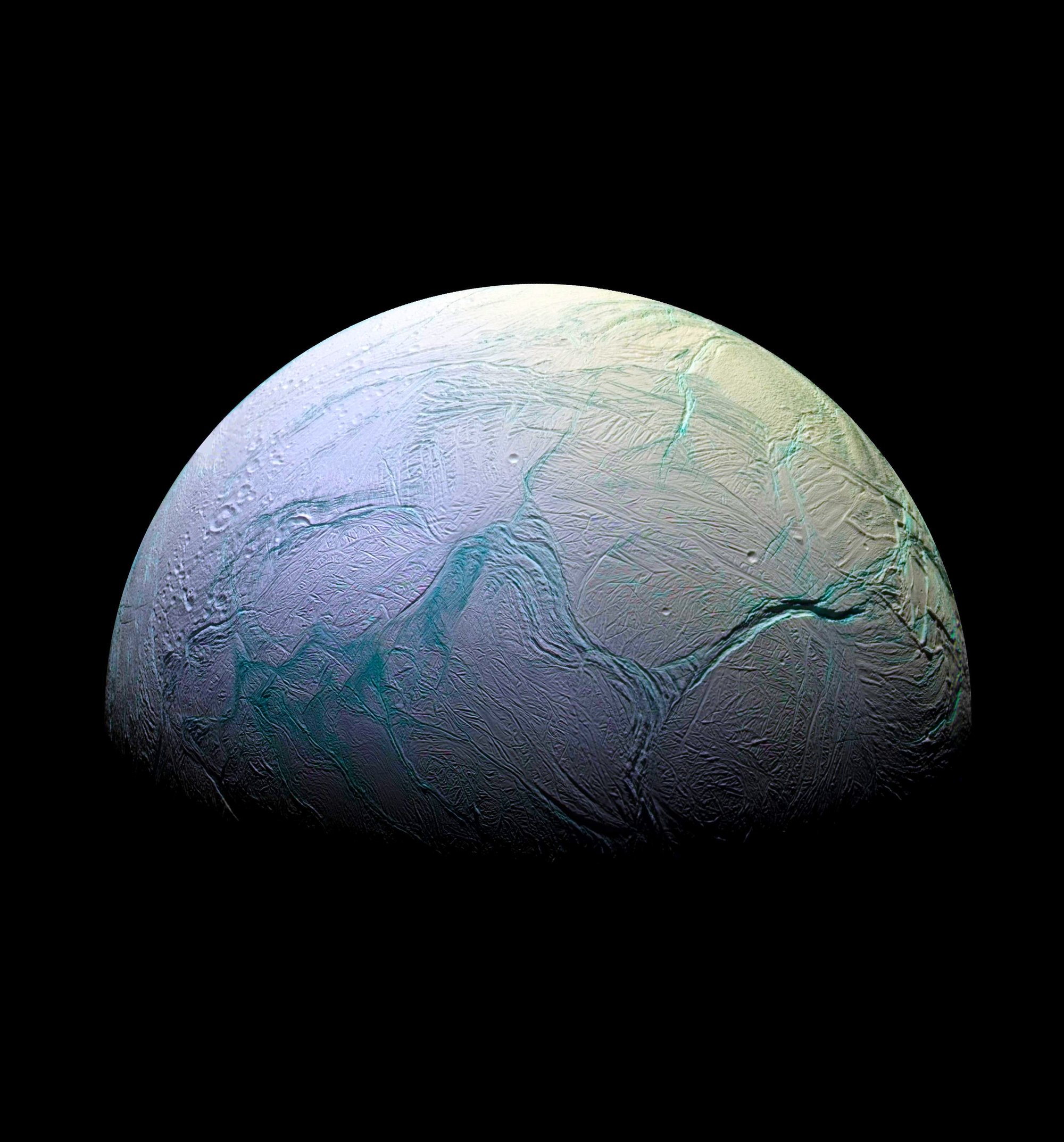
Scientists studying Saturn’s icy moon Enceladus say its underground ocean could support microbial life, after experiments found deep-sea bacteria could survive conditions similar to those believed to exist beneath the moon’s frozen surface. Researchers recreated the chemical environment thought to be present in Enceladus’ subsurface ocean and exposed the bacteria "Methanothermococcus okinawensis" to the extreme conditions. The ocean is expected to contain very little oxygen, high levels of dissolved carbon dioxide and highly alkaline water — conditions scientists had considered potentially hostile to life. Dr Nozair Khawaja, of the Freie Universitat Berlin and co-author of the study, said: "This was really a surprise to us. This was an experiment for which we did not expect such a successful outcome." TRENDING Stories Videos Your Say The findings do not demonstrate that life actually exists on Enceladus, but that organisms with unusual metabolisms could theoretically survive there. Enceladus is about 310 miles across, roughly the width of Arizona state, and its surface can reach temperatures of -201C. However beneath that frozen exterior, scientists believe geothermal activity around its rocky core generates enough heat to maintain a substantial ocean of liquid water. Evidence gathered by Nasa’s Cassini spacecraft has made the moon a leading target in the search for extraterrestrial life. During several flybys, Cassini passed through plumes erupting from cracks around Enceladus’ south pole, sampling material originating from the underground ocean. Those observations revealed evidence of hydrothermal activity on the seafloor, as well as organic compounds that could provide ingredients needed to sustain life. The new experiments focused on a microorganism that does not require oxygen. Instead, M. okinawensis uses hydrogen and carbon dioxide, similar to the chemistry found around hydrothermal vents on Earth. Co-author Professor Frank Postberg, a planetary scientist at Freie Universität Berlin, told the Daily Mail: "On early Earth there was no oxygen either, and these ancient microbes have developed under these conditions." LATEST SPACE DEVELOPMENTS Britain's first space squadron to protect sovereign satellites Asteroid larger than St Paul's Cathedral smashed into Moon in 'once-in-a-lifetime' collision US confirms space weapon deployed into Earth's orbit for first time amid Russia and China threat The bacteria also adapted to the relatively small amounts of carbon dioxide used in the simulated environment, challenging assumptions about whether Enceladus’ alkaline ocean would prevent such organisms from growing. Professor Postberg said the findings show that life "could" survive on Enceladus, but added: "It is by no means certain that it actually does." A separate study by Professor Postberg suggests that, if life is present, its chemical traces could be easier to detect than previously thought. Ocean droplets are propelled into space through fractures near the south pole, carried by water vapour at speeds of up to 620 miles per hour. Scientists had expected the droplets to freeze almost immediately. New modelling and lab experiments instead indicate that freezing happens gradually, and as the water freezes, salts and other minerals become concentrated in different parts of each droplet. If the resulting ice breaks apart, individual fragments could contain highly concentrated samples of particular chemicals. Researchers say this natural process could effectively prepare material for analysis, making potential biological signatures easier to identify. "Enceladus actually does a lot of the work for us in preparing samples for analysis that usually take a lot of effort in chemical labs on Earth", said Dr Postberg. The process could be especially useful if molecules associated with biological activity are present in the ocean. While the research does not conclusively establish that Enceladus contains life, it suggests that conditions beneath its ice may be compatible with at least some forms of microbial life, while its naturally ejected material could provide a way to search for evidence. Professor Postberg concluded: "We now have a good chance to detect it. We should go back there and find out." Our Standards: The GB News Editorial Charter
Saturn's moon could hold alien life as scientists make stunning discovery