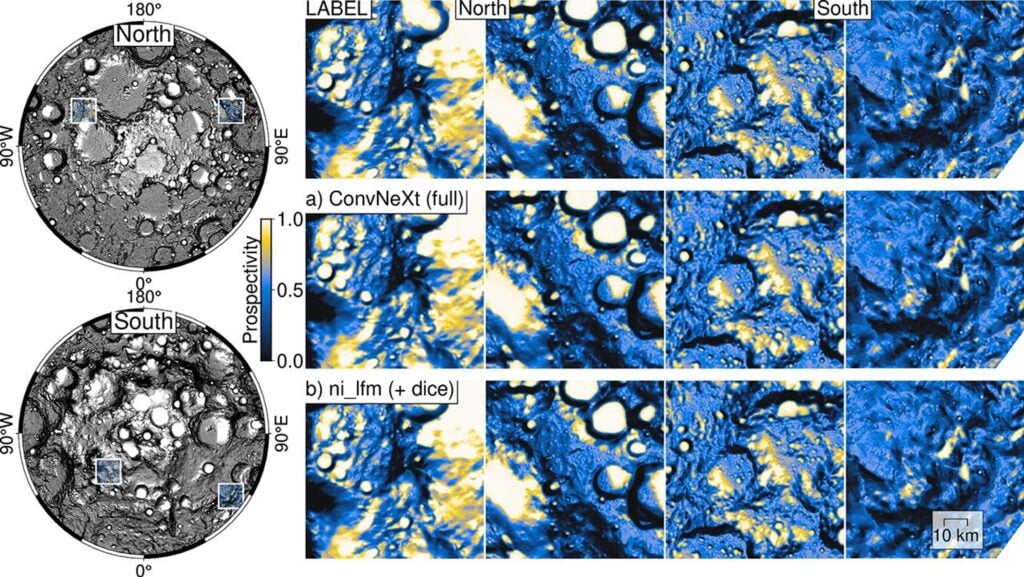
NASA and IBM's open lunar model reduced error by roughly 22 percent on an ice-prospectivity benchmark, while predicting a model-derived stability map rather than measured ice deposits. The post Permanently shadowed craters near the Moon’s poles may preserve water ice that future crews could turn into oxygen and hydrogen-based rocket propellant, potentially supporting lunar bases and eventual Mars expeditions. NASA and IBM have now released an AI model trained on roughly two million lunar images spanning more than 30 data layers—and in testing, it outperformed other leading models at mapping where polar ice is most likely to remain stable. appeared first on Space Daily .
Permanently shadowed craters near the Moon’s poles may preserve water ice that future crews could turn into oxygen and hydrogen-based rocket propellant, potentially supporting lunar bases and eventual Mars expeditions. NASA and IBM have now released an AI model trained on roughly two million lunar images spanning more than 30 data layers—and in testing, it outperformed other leading models at mapping where polar ice is most likely to remain stable.