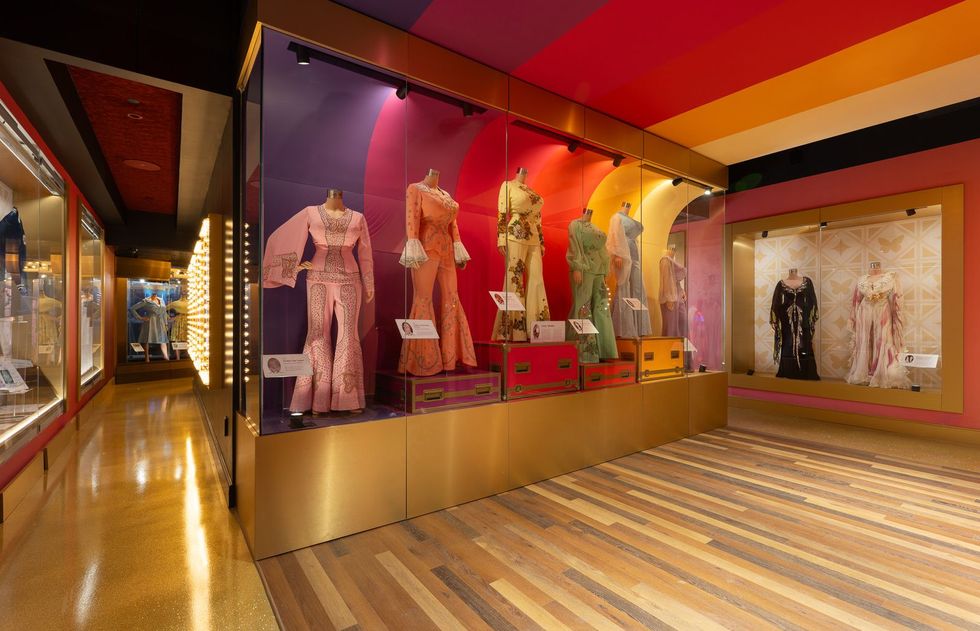
This project transcends traditional legacy preservation by using Dolly Parton’s first-person narration to guide visitors through spaces designed around her personal memories. Rather than simply replicating historical locations, the exhibition recreates the sensory experience and emotional tone of her life and legacy. The narrative explores her multifaceted impact as a Smoky Mountain child, songwriter, performer, television star, businesswoman, and philanthropist. Achieving this level of storytelling required precise, early-stage coordination across architecture, media production, and show set design. Because of this interdisciplinary approach, Dolly Parton's media representations dynamically interact with and gesture toward physical artifacts in the room. By uniting physical environments, sensory details, and direct storytelling from the icon herself, the project seamlessly merges immersive design, living history, and theatre to connect visitors to the memories that shaped her incredible legacy. Traditionally, museums place engagement with physical artifacts at the forefront of the guest experience, leaving media experiences, whether interactive or archival assets in their own right, in the background. When media inclusions are more complex, they can often become isolated from the physical environment, pulling the guest out of the moment rather than deepening it. Dolly’s Life of Many Colors Museum flips this convention. Here, the media is the driving force of the spatial design, and the physical artifacts serve as tactile anchors for the story she is telling. Through the innovative use of "Dollygrams", intimate, chronological audio narrations recorded by Dolly herself, guests are completely immersed in her specific point of view. For instance, as visitors step onto the meticulously fabricated replica of her tour bus or walk through the immersive book tunnel, the audio doesn't just play passively in the background. It is spatially aware and reacts to where they are and what they are looking at. This ensures that her iconic outfits, handwritten lyrics, and personal mementos are never just static objects trapped behind glass. Rather, they are active participants in a living scene. When Dolly speaks about the intricate details of a specific dress or the views from her childhood home in the Smoky Mountains, the lighting, the media screens, and the show set design seamlessly direct the guest’s attention to those exact details. This level of synchronization required the architecture, show set elements, and AV integration to be developed together from day one. There was no traditional "hand-off" between the storytellers and the builders. Instead, the design team engineered the physical environments specifically to serve as a stage for Dolly's voice. Ultimately, the innovation lies in how the museum breaks the fourth wall of traditional curation. By intertwining authentic physical environments with direct, first-person storytelling, the project moves beyond a standard retrospective. It becomes a theatrical, emotionally resonant experience that allows visitors to step directly into the memories, struggles, and triumphs of a global icon, feeling as though she is walking through the journey right beside them.
Dolly's Life of Many Colors Museum: Innovation in Storytelling