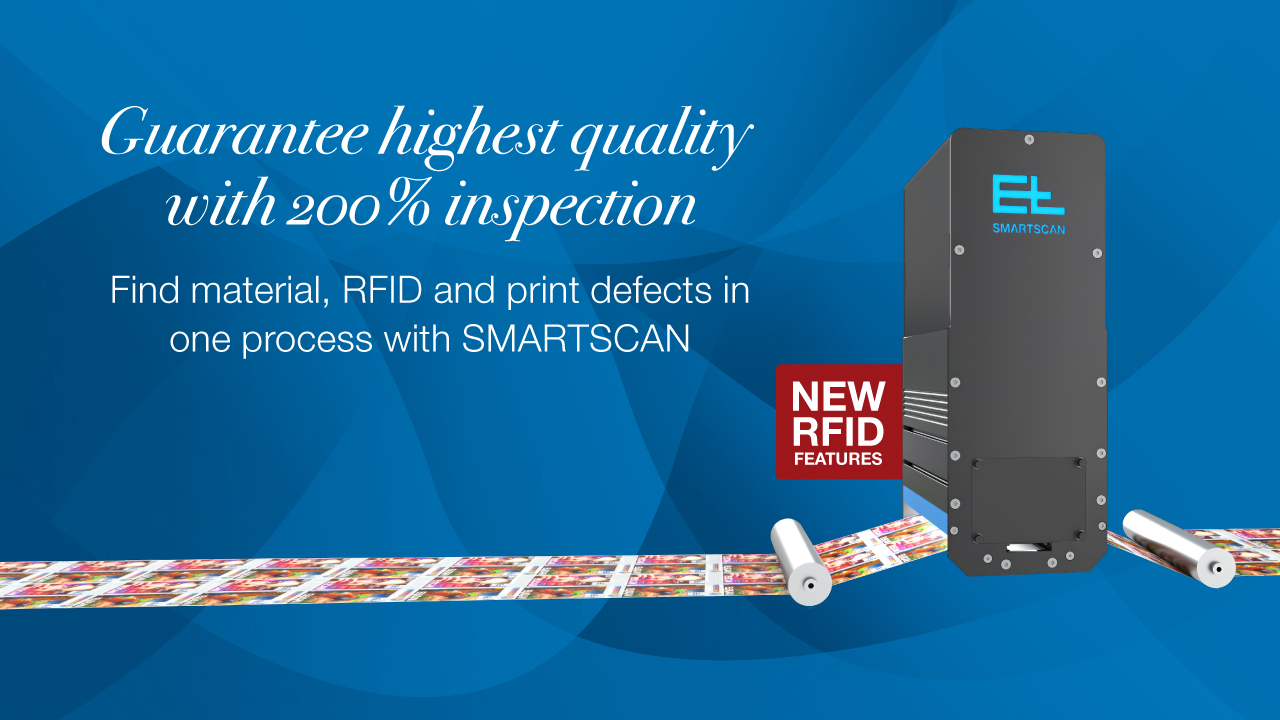
Label manufacturers are under constant pressure to increase production speed while maintaining consistent quality across every meter of material. At the same time, they must detect increasingly complex defects before labels reach downstream processes or arrive at end customers. Missing labels, print defects, splice points, matrix residues, color deviations, and material damage can all lead to waste, rework, customer complaints, and production downtime. Traditional 100 percent inspection systems often focus on only one image stream for top-layer inspection. This approach can identify visible print defects, but it may miss defects located inside the material structure or on the rear side of the web. In applications such as RFID label production, this limitation becomes even more critical, because the RFID inlay is embedded within multiple material layers. While this makes the RFID inlay invisible to top-layer inspection, verifying the integrity and correct position of the RFID inlay is still an important need for RFID label producers. The SmartScan product family from Erhardt+Leimer takes a different approach by combining material, RFID, and print image inspection within a single process. Dual-image inspection for zero undetected defects SmartScan 200 percent inspection system The core of the SmartScan product family is its 200 percent inspection concept for applications in narrow-web printing and finishing. Instead of relying on a single image stream, the system captures two image streams simultaneously with a temporal offset. This approach expands the range of defects that can be detected significantly. One image is generated using incident light and identifies visible print defects such as smears, splashes, color deviations, impurities, or missing labels. The second image is taken using transmitted light and shows material defects not visible to the incident light image stream such as die-cutting deviations, splice points on the rear side of the web, holes, flags, unremoved matrix residues, and other material damage. Even transparent labels and UV-sensitive applications can be processed with the specialized SmartScan UV. The system combines white light and additional UV illumination, enabling reliable inspection of fluorescent colors, UV paints, security markings, and transparent adhesive areas that may not be visible under normal lighting conditions. All images are compared with dedicated reference images, also called golden templates. This approach results in the most comprehensive inspection process for any label production. All detectable defect types with Smartscan’s incident and transmitted light concept But SmartScan is not just a great tool for label producers. For manufacturers processing films, foils, or pharmaceutical packaging materials, the transmitted light method offers an additional benefit. SmartScan can perform reliable pinhole detection while still maintaining print image and material inspection within the same system. This is particularly relevant in industries where material integrity and sealing performance are critical quality requirements. The system also supports surface inspection applications for homogeneous materials such as paper or film. Depending on the production requirement, SmartScan can identify impurities, insects, damage, or other surface defects. Automated defect classification and logging functions help operators document production quality and analyze recurring defect patterns. Extending inspection to RFID inlays RFID label production creates additional inspection challenges because the RFID antenna and chip are embedded between multiple material layers. Surface inspection alone cannot reliably identify defects inside the RFID inlay structure or its correct position within the label. Different layers of RFID labels SmartScan RFID extends the 200 percent inspection concept to RFID applications. Using transmitted light inspection, the system can detect antenna breaks, incorrect inlay positioning, inclusions, tears, and damages within the RFID layer itself. The system automatically detects the RFID antenna based on contrast values and monitors whether the inlay position remains within defined tolerances. If positioning tolerances are exceeded, the defect is identified immediately during production. Typical defects in RFID Processing This allows operators to correct issues before defective labels continue through downstream converting processes. At the same time, incident light inspection continues to monitor the printed label surface for visible defects. SmartScan RFID also supports variable code inspection and optical character recognition. The system can read and archive, for example, QR codes, barcodes, text, and serial numbers and compare them with reference data to identify duplicates or verification errors. Excellent inspection performance is not enough In modern label production, manufacturers need more than reliable quality control. Production lines must run efficiently, job changes need to happen quickly, and operators require systems that simplify workflows instead of adding complexity. SmartScan was developed specifically to support these requirements: stable and efficient production with minimal operational effort. The one-click operating concept reduces setup times and minimizes the need for extensive operator training. This allows production teams to start jobs faster and focus on output and process stability instead of time-consuming system configuration. The compact system design also simplifies integration into existing printing and finishing lines without extensive machine modifications. For producers processing multiple job types, fast access to stored job parameters and repeat-job settings helps reduce changeover times and improves production consistency across recurring orders. In addition, remote maintenance capabilities and protected system data help maintain operational stability and ensure reliable access to production information over time. Process transparency is another key factor. Manufacturers increasingly rely on production data to identify repetitious issues, optimize workflows, and reduce avoidable waste over time. SmartScan supports this with automated defect logging, inspection reports, counting functions, archived production data, and repeat-job management. These functions provide a structured basis for production analysis and continuous process improvement. Supporting stable quality in modern label production As quality requirements in label and RFID production continue to increase, manufacturers need inspection systems that go beyond traditional print inspection. SmartScan, SmartScan UV, and SmartScan RFID combine print image inspection, material inspection, and RFID inlay inspection within one integrated platform and help ensure consistent product quality and process transparency in modern production environments. Further information about SmartScan is available on the E+L website . Posted date 3 hours 6 minutes ago Short title 200 percent inspection for RFID labels Short summary Smartscan combines material, RFID and print image inspection for modern label productions. First paragraph Smartscan combines material, RFID and print image inspection for modern label productions. Regions Asia-Pacific Europe Middle East North America South & Central America Southeast Asia Africa South Asia Related suppliers Erhardt & Leimer Rate Select rating Give it 1/5 Give it 2/5 Give it 3/5 Give it 4/5 Give it 5/5 Cancel rating No votes yet Top story Off Article main topic Workflow, MIS & inspection Redirected Off Moved to features Off Lead image: New batch Off Sponsor type Sponsored Start date Sat, 20/06/2026 - 12:00 End date Tue, 30/06/2026 - 12:00 redirected Off
200 percent inspection for RFID labels